

Three US Private Microreactors Go Critical in One Month — 150 Days From Kickoff, Beating Trump's July 4 Deadline
TL;DR
Three US private startups pushed advanced microreactors to criticality in a single June, meeting Trump's July 4, 2026 deadline; Deployable Energy went from kickoff to criticality in 150 days.
Three US private nuclear startups pushed advanced microreactors to criticality within a single month in June 2026, hitting the July 4 deadline in Trump's May 2025 Executive Order 14301, all under DOE authorization rather than the standard NRC licensing track.
Antares Nuclear (Torrance, CA) took its Mark-0 critical at Idaho National Lab in early June — the 53rd reactor ever to reach criticality in the United States and the first privately funded non-light-water reactor to do so in 40 years. The same design is in test at NASA's Marshall Space Flight Center as a candidate lunar-base power source; a military order locks in a 2027 delivery to Joint Base San Antonio.
Valar Atomics (El Segundo, CA) took its Ward 250 critical first at Los Alamos National Lab, then again in June at Utah's San Rafael Energy Lab, delivering 100 kW on July 1. The funding side was hotter: a $450M round at a $2 billion valuation, alongside a partnership with NVIDIA on a 30 MW nuclear-powered datacenter.
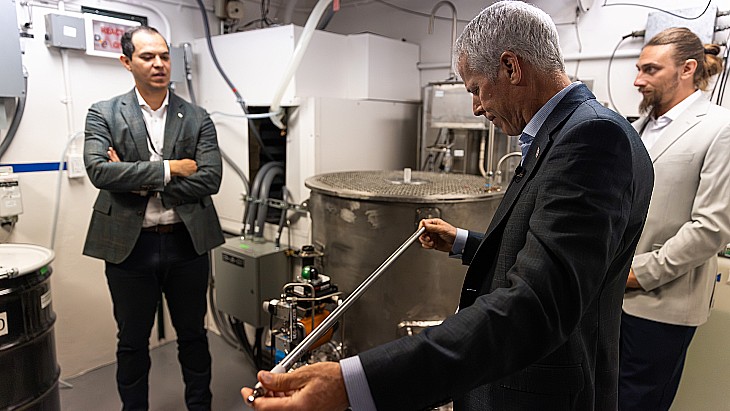
Deployable Energy (Houston, TX) took its Unity Nuclear Battery critical at INL at 23:55 MDT on June 30 — 150 days from project kickoff to criticality, on a total budget in the "single-digit millions." The company is one year old and demonstrated portability by driving the reactor core in a Ford F-150. It ran through the DOE's new Nuclear Energy Launch Pad track, bypassing the standard NRC process. Aalo Atomics came a few days short at INL, sitting fourth on the deadline board.
INL director John Wagner on Unity: "Achieving criticality in roughly 150 days is a remarkable accomplishment" on a timeline widely considered impossible. Energy Secretary Chris Wright: "A significant milestone on a timeline many thought was unachievable."
Bet won: US nuclear compresses a 40-year licensing cycle under six months, and AI datacenters get an off-grid power option. Bet lost: any one of the three trips on the next round of reactor-physics validation, load-following, or full-power tests, and Congress can pull the entire "accelerate via DOE, skip NRC" plumbing back overnight.
via World Nuclear News / Forbes / PBS News / US Army / Interesting Engineering
Antares Nuclear (Torrance, CA) took its Mark-0 critical at Idaho National Lab in early June — the 53rd reactor ever to reach criticality in the United States and the first privately funded non-light-water reactor to do so in 40 years. The same design is in test at NASA's Marshall Space Flight Center as a candidate lunar-base power source; a military order locks in a 2027 delivery to Joint Base San Antonio.
Valar Atomics (El Segundo, CA) took its Ward 250 critical first at Los Alamos National Lab, then again in June at Utah's San Rafael Energy Lab, delivering 100 kW on July 1. The funding side was hotter: a $450M round at a $2 billion valuation, alongside a partnership with NVIDIA on a 30 MW nuclear-powered datacenter.
Deployable Energy (Houston, TX) took its Unity Nuclear Battery critical at INL at 23:55 MDT on June 30 — 150 days from project kickoff to criticality, on a total budget in the "single-digit millions." The company is one year old and demonstrated portability by driving the reactor core in a Ford F-150. It ran through the DOE's new Nuclear Energy Launch Pad track, bypassing the standard NRC process. Aalo Atomics came a few days short at INL, sitting fourth on the deadline board.
INL director John Wagner on Unity: "Achieving criticality in roughly 150 days is a remarkable accomplishment" on a timeline widely considered impossible. Energy Secretary Chris Wright: "A significant milestone on a timeline many thought was unachievable."
Bet won: US nuclear compresses a 40-year licensing cycle under six months, and AI datacenters get an off-grid power option. Bet lost: any one of the three trips on the next round of reactor-physics validation, load-following, or full-power tests, and Congress can pull the entire "accelerate via DOE, skip NRC" plumbing back overnight.
via World Nuclear News / Forbes / PBS News / US Army / Interesting Engineering