

Company data puts a 14nm chip above H200 bandwidth — DF1000 has no independent benchmark
TL;DR
Dongfang Suanxin claims 6.4 TB/s for its 14nm, HBM-free DF1000; production and performance remain unverified.
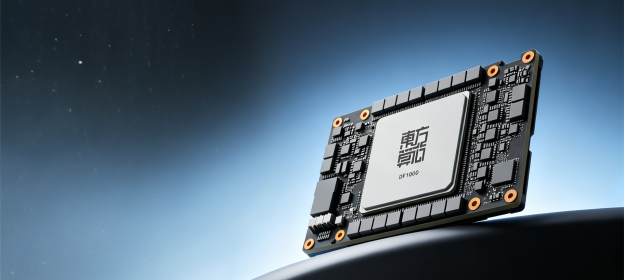
Shanghai startup Dongfang Suanxin said on July 13 that its 14nm DF1000 AI chip reaches 6.4 TB/s of memory bandwidth without HBM, above NVIDIA H200's 4.8 TB/s. Its published specifications also list 520 TFLOPS of BF16 compute and 900 GB/s of scale-up interconnect bandwidth. The company said the chip is ready for mass production and plans shipments by the end of 2026.
Dongfang Suanxin said DF1000 combines a software-defined chip with 3D-stacked near-memory computing. Chairman and CEO Wei Shaojun said spatial parallelism and time-division multiplexing improve utilization, while vertical integration shortens interconnects and allows conventional memory to replace export-restricted HBM. The company also said wafer fabrication, packaging, testing, servers and clusters use a Chinese supply chain.
Using company figures, 6.4 TB/s is about 33% above H200's 4.8 TB/s, while 520 TFLOPS BF16 is about 52.6% of the 989 TFLOPS listed for a single H100 or H200. Memory bandwidth and compute throughput are different measurements. Dongfang Suanxin has not published reproducible third-party benchmarks, power consumption, memory capacity, overall yield or software-compatibility tests.
Wei used two layers at 90% yield each to illustrate an 81% combined yield and said process technology still limits performance. Dongfang Suanxin said DF2000 targets a doubling of each metric in the fourth quarter of 2026 and DF3000 targets another doubling in the fourth quarter of 2027. The performance, production and supply-chain statements remain company claims without independent testing.
via TrendForce / SCMP / Jiemian News
Dongfang Suanxin said DF1000 combines a software-defined chip with 3D-stacked near-memory computing. Chairman and CEO Wei Shaojun said spatial parallelism and time-division multiplexing improve utilization, while vertical integration shortens interconnects and allows conventional memory to replace export-restricted HBM. The company also said wafer fabrication, packaging, testing, servers and clusters use a Chinese supply chain.
Using company figures, 6.4 TB/s is about 33% above H200's 4.8 TB/s, while 520 TFLOPS BF16 is about 52.6% of the 989 TFLOPS listed for a single H100 or H200. Memory bandwidth and compute throughput are different measurements. Dongfang Suanxin has not published reproducible third-party benchmarks, power consumption, memory capacity, overall yield or software-compatibility tests.
Wei used two layers at 90% yield each to illustrate an 81% combined yield and said process technology still limits performance. Dongfang Suanxin said DF2000 targets a doubling of each metric in the fourth quarter of 2026 and DF3000 targets another doubling in the fourth quarter of 2027. The performance, production and supply-chain statements remain company claims without independent testing.
via TrendForce / SCMP / Jiemian News