

India's first private orbital rocket lifts off | Vikram-1 crashes SpaceX's party
TL;DR
Indian startup Skyroot Aerospace launched Vikram-1, India's first privately developed orbital rocket, on July 18. The "Aagaman" test flight can lift 350 kg to LEO; Skyroot became India's first billion-dollar space startup this year.
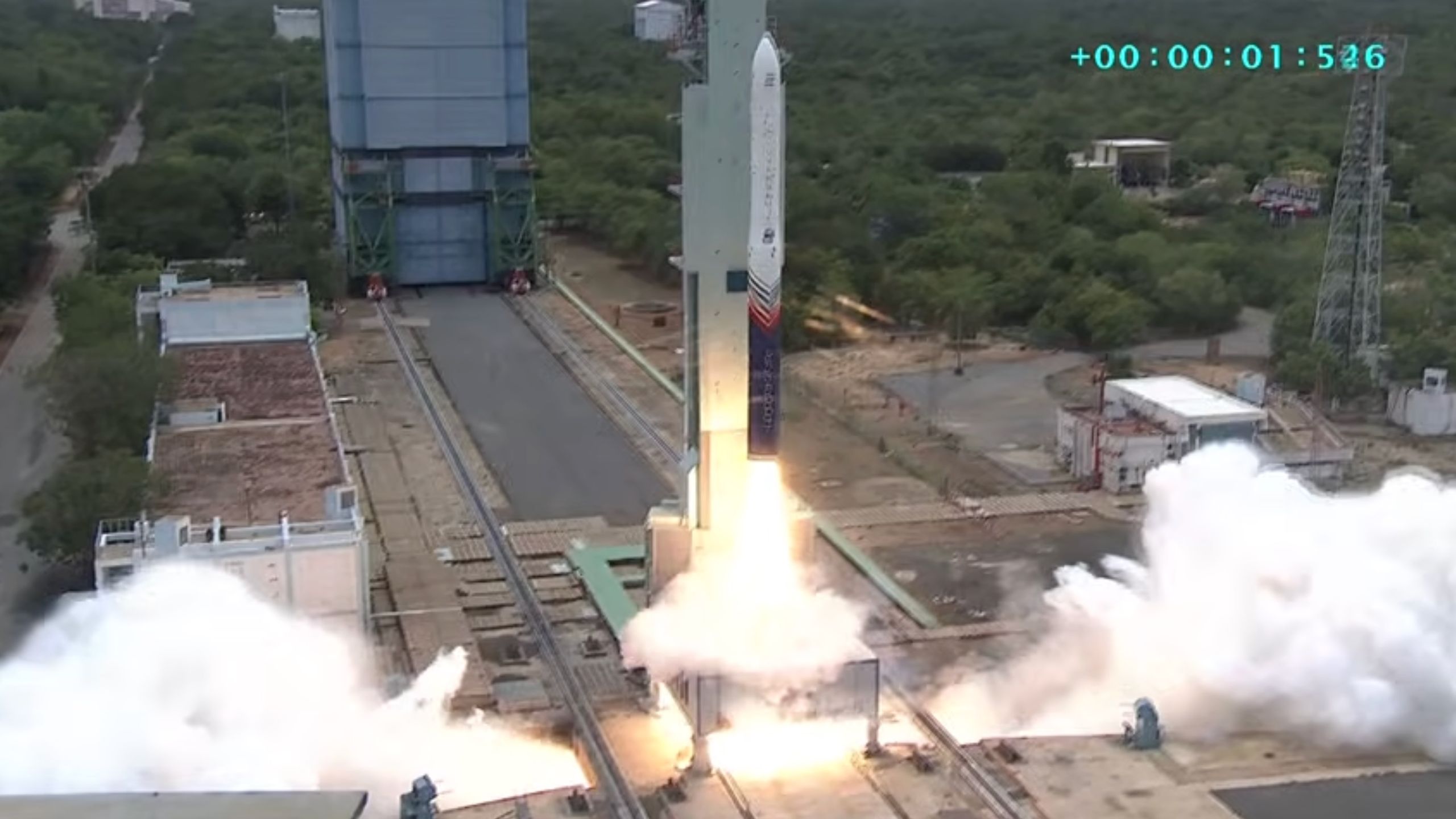
Indian space startup Skyroot Aerospace successfully launched India's first privately developed orbital rocket on July 18. The roughly 22-meter Vikram-1 lifted off at 2:35 pm Singapore time from the Satish Dhawan Space Centre on Sriharikota island, trailing a column of flame and smoke.
The debut, codenamed Aagaman ("Arrival"), is a test flight. Vikram-1 is a four-stage vehicle — three solid-propellant stages plus a liquid fourth stage for orbital insertion and precise maneuvers — designed to put small satellites of up to 350 kg into low Earth orbit. This flight carried multiple customer payloads and in-orbit experiments, aiming to validate the propulsion, avionics, telemetry, guidance-navigation-control and stage-separation systems while gathering data.
Founded in 2018 and based in Hyderabad, Skyroot flew India's first private suborbital mission, Vikram-S, in November 2022. This year it became India's first space company to cross a $1 billion valuation. The rocket is named after Vikram Sarabhai, the father of India's space program. "This is a test flight. We'll do a few more like this before regular commercial flights," the company said.
The small-satellite launch market is getting crowded, with a wave of startups lining up to challenge SpaceX-led incumbents. India wants a bigger slice — and first it has to prove its home-grown private rocket can reach orbit reliably.
via Space.com / Lianhe Zaobao
The debut, codenamed Aagaman ("Arrival"), is a test flight. Vikram-1 is a four-stage vehicle — three solid-propellant stages plus a liquid fourth stage for orbital insertion and precise maneuvers — designed to put small satellites of up to 350 kg into low Earth orbit. This flight carried multiple customer payloads and in-orbit experiments, aiming to validate the propulsion, avionics, telemetry, guidance-navigation-control and stage-separation systems while gathering data.
Founded in 2018 and based in Hyderabad, Skyroot flew India's first private suborbital mission, Vikram-S, in November 2022. This year it became India's first space company to cross a $1 billion valuation. The rocket is named after Vikram Sarabhai, the father of India's space program. "This is a test flight. We'll do a few more like this before regular commercial flights," the company said.
The small-satellite launch market is getting crowded, with a wave of startups lining up to challenge SpaceX-led incumbents. India wants a bigger slice — and first it has to prove its home-grown private rocket can reach orbit reliably.
via Space.com / Lianhe Zaobao