

Korea's biggest industrial bet ever: $519B on memory fabs, DRAM output to double in five years
TL;DR
Lee Jae Myung commits 800 trillion won for four memory fabs in southwest Korea, two each for Samsung and SK hynix. DRAM output doubles in five years; Yongin completion pulled forward by 7–12 years.
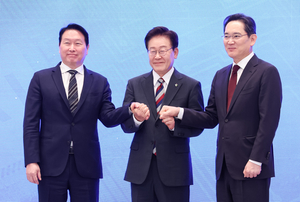
South Korean President Lee Jae Myung announced on June 29 that Samsung Electronics and SK hynix will jointly invest 800 trillion won — about $519 billion — to build four memory fabs in Gwangju and South Jeolla. At the same ceremony, the industry minister set a hard deadline: DRAM output is to double within five years.
Each company takes two fabs, lifting the southwest into Korea's second-largest semiconductor base. A further 81 trillion won funds HBM packaging hubs in Cheonan and Onyang in South Chungcheong. Adding the capital-region pipeline on top, Samsung's domestic commitment reaches roughly 2,655 trillion won and SK hynix's tops 1,100 trillion — a single-industry record.
The harder part is the schedule. SK hynix's Yongin complex, originally due in 2045, must now be completed by 2033 — twelve years ahead of plan. Samsung's Yongin project moves up seven years to 2040. The wager behind it: the global memory market grows from $200 billion in 2025 to $800 billion by 2030, with AI demand turning HBM and DDR5 into strategic commodities.
Lee called Samsung Chairman Lee Jae-yong and SK Chairman Chey Tae-won «national heroes» on stage, and wrote 18.4 GW of AI data-center capacity by 2035 into national policy. SK Group, GS Group and Naver are layering another $648 billion of data-center spending on top.
The dispute surfaced the same day. Opposition lawmakers argued that Gwangju and South Jeolla — Lee's electoral base — are not the commercially optimal sites. Lee's reply was brief: the region has «untapped power resources». Industry's quieter read: capital-region fab expansion has been jammed up by environmental review and grid bottlenecks for a decade, so moving capacity south is, in effect, buying construction time with political capital.
Win the bet, Korea sets the global DRAM price in 2030. Lose it, and 2,655 trillion won goes down as the most expensive political cheque in history.
via The Korea Herald / Al Jazeera / Korea Times / CNBC
Each company takes two fabs, lifting the southwest into Korea's second-largest semiconductor base. A further 81 trillion won funds HBM packaging hubs in Cheonan and Onyang in South Chungcheong. Adding the capital-region pipeline on top, Samsung's domestic commitment reaches roughly 2,655 trillion won and SK hynix's tops 1,100 trillion — a single-industry record.
The harder part is the schedule. SK hynix's Yongin complex, originally due in 2045, must now be completed by 2033 — twelve years ahead of plan. Samsung's Yongin project moves up seven years to 2040. The wager behind it: the global memory market grows from $200 billion in 2025 to $800 billion by 2030, with AI demand turning HBM and DDR5 into strategic commodities.
Lee called Samsung Chairman Lee Jae-yong and SK Chairman Chey Tae-won «national heroes» on stage, and wrote 18.4 GW of AI data-center capacity by 2035 into national policy. SK Group, GS Group and Naver are layering another $648 billion of data-center spending on top.
The dispute surfaced the same day. Opposition lawmakers argued that Gwangju and South Jeolla — Lee's electoral base — are not the commercially optimal sites. Lee's reply was brief: the region has «untapped power resources». Industry's quieter read: capital-region fab expansion has been jammed up by environmental review and grid bottlenecks for a decade, so moving capacity south is, in effect, buying construction time with political capital.
Win the bet, Korea sets the global DRAM price in 2030. Lose it, and 2,655 trillion won goes down as the most expensive political cheque in history.
via The Korea Herald / Al Jazeera / Korea Times / CNBC